# Claude BugHunter
> A Claude Code skill bundle for bug hunting and external red-team work - 82 skills, 15 slash commands, 681 disclosed-report patterns curated across 24 core vulnerability classes, plus enterprise identity + infrastructure attack matrices.
Claude BugHunter is an AI skill in the Security category, published by elementalsouls.
## Key facts
- Type: Skill
- Category: Security
- Version: 1.0.0
- License: MIT
- Author: elementalsouls (https://github.com/elementalsouls)
- Installs: 0
- GitHub stars: 19.4K
- Updated: 23 Nov 2026
- Source: https://github.com/elementalsouls/Claude-BugHunter
- Page: https://aiskillshq.com/skills/claude-bughunter
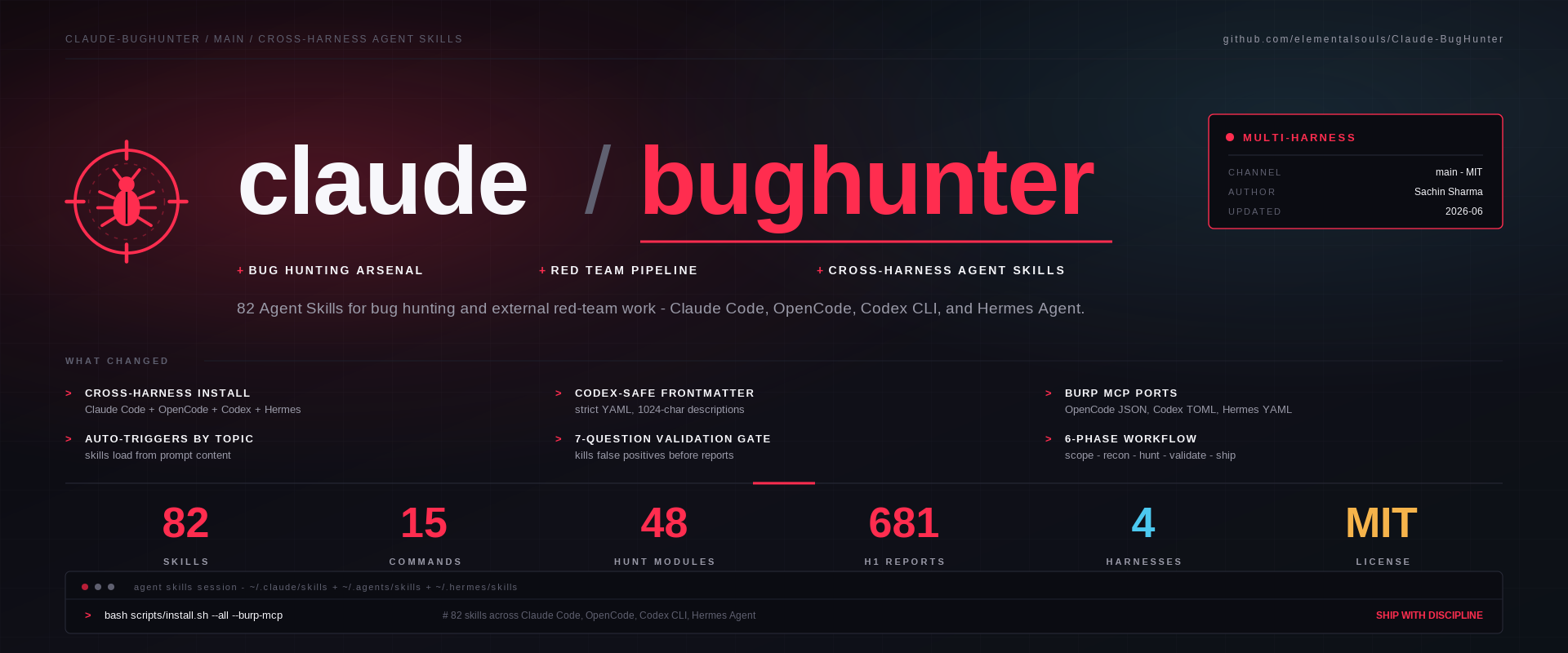
# claude-bughunter
> A self-contained Claude skill bundle for bug hunting and external red-team work · **83 skills** · 15 slash commands · **681 disclosed-report patterns** (433 now individually cited & auditable) across 24 core vulnerability classes · enterprise identity + infrastructure attack matrices · engagement-folder scaffolding · Burp MCP integration · battle-tested across authorized red-team and bug-hunting engagements, plus public training platforms (DVWA, OWASP Juice Shop, Hacker101, testphp.vulnweb.com).
Built by **[Sachin Sharma](https://www.linkedin.com/in/sachinsharma8080/)** — Bug Hunting & GenAI Security Research.
SPONSORED BY
---
## What is this?
`claude-bughunter` is a drop-in skill bundle for the [Claude Code skills system](https://docs.claude.com/en/docs/claude-code/skills). Install once and Claude Code stops being a chatbot and starts behaving like a senior bug-hunting researcher or red-team operator: it knows the techniques, the chain templates, the VRT mappings, the platform CVE chains, and the hygiene — and it stays in scope.
Four layers stack:
- **Think** — `bb-methodology` + `redteam-mindset`: the 5-phase non-linear workflow, critical-thinking framework, and red-team operator discipline.
- **Hunt webapps** — 58 `hunt-*` skills curated from 681 disclosed HackerOne reports: per-class detection patterns, payloads, bypass tables, and chain templates.
- **Hit the perimeter** — enterprise platform chains (M365/Entra, Okta, vCenter, SSL-VPN appliances, SharePoint, cloud IAM): current 2024–2026 CVE chains + post-credential escalation.
- **Ship it** — `triage-validation` + reporting + `evidence-hygiene`: the 7-Question Gate, VRT-aware severity, OOS rebuttals, PII redaction, and red-team deliverables.
All triggered automatically by topic — describe what you're testing in plain English and the relevant skill loads. No invocation by name.
---
## Quickstart
**Option A — install as a Claude Code plugin (recommended).** From inside Claude Code:
```text
/plugin marketplace add elementalsouls/Claude-BugHunter
/plugin install claude-bughunter@elementalsouls
```
All 83 skills + 15 commands load namespaced under `claude-bughunter:` and update when you bump the plugin version — no files copied into `~/.claude/`.
**A HackerOne account is optional.** The install asks for a HackerOne API username and token. They only let the HackerOne MCP read your private programs and your own reports; leave both blank if you don't need that. Every skill, command and the MCP's public tools (duplicate search, program scope) work without them.
**Option B — copy install (no plugin system / pin to a clone):**
```bash
git clone https://github.com/elementalsouls/Claude-BugHunter.git
cd Claude-BugHunter
```
```bash
# macOS / Linux
bash scripts/install.sh
# Windows (PowerShell)
pwsh ./scripts/install.ps1
```
Both copy the skills + commands into `~/.claude/` (macOS/Linux) or `%USERPROFILE%\.claude\` (Windows) and wire the `hunt` engagement scaffolder.
**What each install path gives you:**
| Path | 83 skills + 15 slash commands | `cbh` CLI | `hunt` scaffolder |
|---|---|---|---|
| **A — plugin** | ✅ namespaced under `claude-bughunter:` | ➕ separate `pipx install` | ❌ clone-only |
| **B — copy install** | ✅ copied into `~/.claude/` | ✅ from the clone | ✅ from the clone |
The plugin is the fastest path to the skills + slash commands. The terminal-native
`cbh` runner installs standalone — `pipx install git+https://github.com/elementalsouls/Claude-BugHunter`
— so plugin users can add it without a full clone (see [`cbh` CLI](https://github.com/elementalsouls/Claude-BugHunter/blob/main/docs/cbh-cli.md)).
The `hunt` engagement scaffolder ships with the clone (Option B).
That's it. Open Claude Code and describe what you're testing in plain English — the right skill loads automatically, no invocation by name:
```text
> Testing acme.com — an in-scope HackerOne target. Run recon and rank the surface.
⟳ loading skills: web2-recon, offensive-osint, bb-methodology …
→ subdomain enum (subfinder + crt.sh) … 47 hosts
→ live hosts (httpx) … 12 · tech fingerprint … 6 distinct stacks
→ ranked surface: api.acme.com (GraphQL, introspection ON) ← start here
auth.acme.com (OAuth, SSO) ← hunt-oauth
Next: want me to probe the GraphQL introspection + OAuth redirect_uri?
```
→ Full [Installation guide](https://github.com/elementalsouls/Claude-BugHunter/blob/main/INSTALL.md) · [Usage guide](https://github.com/elementalsouls/Claude-BugHunter/blob/main/USAGE.md) · [searchable skill catalog](https://github.com/elementalsouls/Claude-BugHunter/blob/main/docs/skills.md).
> The block above is an illustrative transcript. To record a real demo of your own session: `asciinema rec demo.cast` → upload to [asciinema.org](https://asciinema.org) and drop the badge here.
---
## Runs on multiple agent harnesses
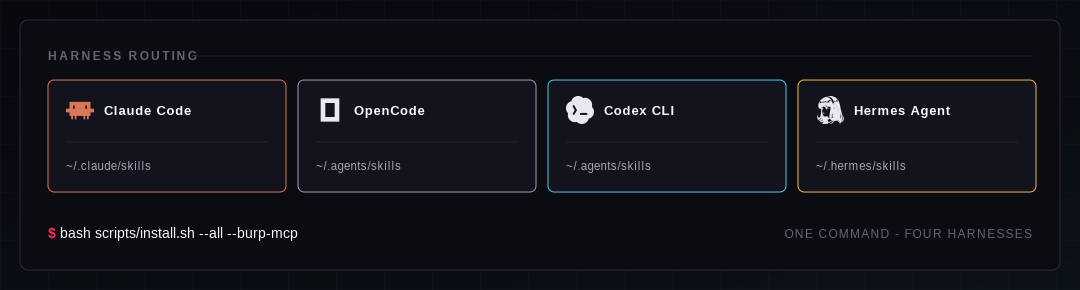
The skills are plain [Agent Skills](https://docs.claude.com/en/docs/claude-code/skills) — the same `SKILL.md` format that **Claude Code · OpenCode · OpenAI Codex CLI · Hermes Agent · Google AntiGravity** all load. One command installs them everywhere:
```bash
# macOS / Linux
bash scripts/install.sh --all --burp-mcp
# Windows (PowerShell)
pwsh ./scripts/install.ps1 -All -BurpMcp
```
| Harness | Target Skill Directory | Flag |
|---|---|---|
| **Claude Code** (baseline) | `~/.claude/skills/` | *(default)* |
| **OpenCode** | reads `~/.claude/skills/` & `~/.agents/skills/` | *(default)* / `--agents` |
| **OpenAI Codex CLI** | `~/.agents/skills/` | `--agents` |
| **Hermes Agent** | `~/.hermes/skills/` | `--hermes` |
| **Google AntiGravity** | `~/.gemini/config/skills/` | `--antigravity` |
`--all` (`-All`) detects installed harnesses and copies skills to each harness's path (`~/.claude/skills`, `~/.agents/skills`, `~/.hermes/skills`, `~/.gemini/config/skills`); `--burp-mcp` (`-BurpMcp`) wires the Burp MCP server into each. The full *knowledge* layer ports to all five — the slash commands and `/hunt` engine stay Claude-Code-only by design.
→ [Multi-harness guide](https://github.com/elementalsouls/Claude-BugHunter/blob/main/docs/multi-harness.md)
---
## Star History
Chart is self-hosted — regenerate with `python3 scripts/gen_star_history.py` (needs `gh auth login`).
Refreshes automatically each day via `.github/workflows/star-history.yml`.
---
## Scope — what this bundle is for, and what it isn't
This bundle covers the **external attack surface** — anything reachable from the internet without first compromising an internal endpoint.
### In scope
- **Bug bounty hunting** — web apps, APIs, SaaS, GraphQL, OAuth, JWT, file upload, IDOR, SSRF, RCE chains
- **Web application pentesting** — full hunt-* coverage of OWASP-mapped bug classes + discipline rules
- **External red-team engagements** — initial-access against internet-facing enterprise estate: M365 / Entra ID, Okta-as-IdP, SharePoint on-prem (ToolShell + legacy SOAP), VMware vCenter / Workspace ONE, SSL VPN appliances (Cisco / Fortinet / Citrix / Palo Alto / Pulse / SonicWall / F5), Android APK red-team, supply-chain recon
- **Cloud misconfig + post-credential escalation** — public S3, IMDS chains, STS AssumeRole, cross-account confused-deputy
- **Recon + OSINT** — subdomain enum, identity-fabric mapping, certificate transparency, JS analysis, secret scanning
- **Reporting** — H1, Bugcrowd (VRT-aware), Intigriti, Immunefi, plus client-facing red-team deliverable format
### Out of scope (deliberate — not gaps, design decisions)
- **Internal Active Directory attacks** — BloodHound, Kerberoasting, ASREProast, DCSync, Pass-the-Hash, AD CS abuse, ntlmrelayx, Responder, PetitPotam, etc. Different operational risk profile; needs different tooling and judgment. **Future bundle, not this one.**
- **C2 frameworks** — Cobalt Strike, Sliver, Mythic, Havoc, BRC4 tradecraft. Out of scope for external-only engagement model.
- **Post-exploit / persistence / lateral** — Mimikatz/comsvcs LSASS dumping, golden/silver tickets, named-pipe impersonation, persistence (registry, scheduled tasks, WMI events, COM hijacking), token theft. These start after the perimeter has already broken — different bundle territory.
- **Evasion** — AMSI bypass, ETW patching, AV/EDR bypass. Tied to C2 tradecraft above.
- **iOS pentesting / hardware / RF / ICS** — out of scope by design.
- **Binary exploitation / kernel pwn / browser internals** — different skill universe.
If you're running an internal red team that includes domain-takeover chains via Kerberos or lateral movement, **this bundle won't help you in those phases** — and we'd rather say that up front than have you find out mid-engagement. The external surface handoff to internal-RT tooling (Impacket, NetExec, CrackMapExec, Rubeus, Certify, BloodHound) is intentionally outside our scope. **Coverage for internal AD and post-exploit may come in a future update.**
---
## What's inside
**83 skills**, auto-loaded by topic — no invocation by name. Coverage across the external attack surface:
| Category | # | Examples |
|---|---|---|
| Hunt — web app vuln classes | 58 | XSS, SQLi, SSRF, IDOR, LFI, SSTI, XXE, CSRF, CORS, open-redirect, SharePoint, ASP.NET/NTLM |
| Enterprise platform attack ★ | 10 | M365/Entra, Okta, cloud-IAM-deep, vCenter, enterprise VPN, APK/iOS red-team pipelines, supply-chain recon |
| Reporting & validation | 6 | triage-validation, evidence-hygiene, report-writing, bugcrowd-reporting |
| Recon & OSINT | 5 | web2-recon, offensive-osint, osint-methodology, recon-scope-triage |
| Methodology & mindset | 4 | bb-methodology, bug-bounty, redteam-mindset, bb-local-toolkit |
Full searchable catalog → **[docs/skills.md](https://github.com/elementalsouls/Claude-BugHunter/blob/main/docs/skills.md)**. Also ships **15 slash commands** (`/hunt`, `/recon`, `/report`, …) and a deterministic **engagement engine** (`engine/`) that maps a target's attack surface and routes each finding to the skill that handles it.
---
## How it works
A 6-phase, non-linear workflow — **recon → map & rank → hunt → validate → report** — with scope enforced in code and a **7-Question Gate** before anything is submitted. Two ways to drive it:
- **Plain English** — describe what you're testing and the relevant skill loads automatically.
- **`/hunt` scaffold + `cbh` CLI** — engagement-folder structure, state, and orchestration.
→ [Usage guide & worked example](https://github.com/elementalsouls/Claude-BugHunter/blob/main/USAGE.md) · [6-phase architecture & skill-to-phase map](https://github.com/elementalsouls/Claude-BugHunter/blob/main/docs/architecture.md) · [`cbh` CLI](https://github.com/elementalsouls/Claude-BugHunter/blob/main/docs/cbh-cli.md)
---
## Authorization
These skills are intended for assets you **own** or have **written authorization to assess** (bug-bounty in-scope assets, pentest engagement letters, CTF challenges, your own infrastructure).
The skills include validation gates that auto-trigger when you point Claude at unverified third-party targets — `triage-validation`'s 7-Question Gate explicitly asks whether the asset is in scope (Q3) and on the program's accepted-impact list (Q2). The `bugcrowd-reporting` skill includes researcher-side hygiene (Bugcrowdninja alias, account-state restoration, friendly-tester posture) that signals legitimate authorized testing to the target's fraud team.
The bundle explicitly **excludes**: weaponizing 0-days against unauthorized targets, post-exploitation tooling, malware development, mass-targeting infrastructure. See [`SECURITY.md`](https://github.com/elementalsouls/Claude-BugHunter/blob/main/SECURITY.md) for the full posture.
> **Heads-up — Anthropic runtime cyber safeguards.** Anthropic's models apply real-time safeguards that **block "vulnerability exploitation or offensive security tooling development" by default** — so even *authorized, in-scope* work can hit a refusal that isn't this bundle's doing. If you do authorized offensive security (pentest / bug bounty / red team), enroll in Anthropic's **free, application-based [Cyber Verification Program (CVP)](https://claude.com/form/cyber-use-case)** to get safeguards adjusted for legitimate dual-use work. (Mass data exfiltration and ransomware development stay prohibited and are *not* adjustable.) Details: [Anthropic — real-time cyber safeguards](https://support.claude.com/en/articles/14604842-real-time-cyber-safeguards-on-claude).
### Why your model switched mid-session
Separate from refusals, and easy to miss. On **Opus 5**, a narrow set of higher-risk cyber requests —
Anthropic names *exploit generation*, *binary-based vulnerability scanning* and *penetration testing* —
**fall back to Opus 4.8** rather than being refused. You get a notice and the response is labelled with
the model that answered, but in a long agentic run that is easy to scroll past, so it can look like
Opus 5 quietly got worse. See [why Claude switched models](https://support.claude.com/en/articles/16049681-why-claude-switched-models-in-your-conversation-with-opus-5).
What to do depends on what you are actually doing:
| Situation | What helps |
|---|---|
| **Auditing your own code** — reviewing a repo you own for defects | Say so. "Defensive review of my own repo", "check this against the OWASP Top 10", "secure refactor to remediate" describe the work accurately and read as remediation. This is not a workaround; the work genuinely is defensive. |
| **Authorized offensive work** — live engagement, PoC for a bounty submission | This is what the bundle is for, and the supported route is [CVP](https://claude.com/form/cyber-use-case). Do not reword an offensive engagement to look defensive to get past a classifier — enroll instead. |
| **You just want the switching off** | Settings → Capabilities disables automatic model switching. |
`/hunt` states the engagement frame (authorized, scope-bounded, remediable finding) on its first turn
for exactly this reason — engagement context belongs in the session explicitly, not implied.
---
## Documentation
| Doc | Contents |
|---|---|
| [`README.md`](https://github.com/elementalsouls/Claude-BugHunter/blob/main/README.md) | This file — overview, quickstart, scope, skill summary |
| [`INSTALL.md`](https://github.com/elementalsouls/Claude-BugHunter/blob/main/INSTALL.md) | Full setup with Burp MCP integration and optional skill regenerator |
| [`USAGE.md`](https://github.com/elementalsouls/Claude-BugHunter/blob/main/USAGE.md) | Workflow walkthrough · decision tree · worked engagement example |
| [`docs/architecture.md`](https://github.com/elementalsouls/Claude-BugHunter/blob/main/docs/architecture.md) | 6-phase architecture · skill-to-phase mapping · engagement composition |
| [`docs/cbh-cli.md`](https://github.com/elementalsouls/Claude-BugHunter/blob/main/docs/cbh-cli.md) | `cbh` CLI — native runner orchestrating recon + classify + triage + report |
| [`docs/cve-coverage.md`](https://github.com/elementalsouls/Claude-BugHunter/blob/main/docs/cve-coverage.md) | CISA KEV coverage snapshot — refreshed weekly via the workflow template at `docs/automation/cve-refresh.yml.template` |
| [`docs/credits.md`](https://github.com/elementalsouls/Claude-BugHunter/blob/main/docs/credits.md) | Full attribution: 43 original skills + 8 vendored from upstream |
| [`CONTRIBUTING.md`](https://github.com/elementalsouls/Claude-BugHunter/blob/main/CONTRIBUTING.md) | PR guidelines · skill quality standards · scope |
| [`SECURITY.md`](https://github.com/elementalsouls/Claude-BugHunter/blob/main/SECURITY.md) | Authorized-use posture · responsible disclosure · what's excluded |
| [`LICENSE`](https://github.com/elementalsouls/Claude-BugHunter/blob/main/LICENSE) | MIT |
| [`NOTICE`](https://github.com/elementalsouls/Claude-BugHunter/blob/main/NOTICE) | Upstream-skills attribution · no-redistribution note |
| [`LICENSE-CONTENT`](https://github.com/elementalsouls/Claude-BugHunter/blob/main/LICENSE-CONTENT) | CC BY 4.0 (skill methodology, wordlists, docs) |
---
## Why this exists
Most bug-hunting Claude setups are either too generic (one big "security" prompt) or too fragmented (you bookmark 30 disclosed reports and re-read them every engagement). Neither scales past the second target.
This bundle was built and validated through authorized engagements that exposed different capability gaps:
**Bug-bounty engagement** — surfaced four gaps a starter 3-skill stack could not close:
1. **No hypothesis discipline** — drafts written before validation → wasted hours, hurt validity ratio
2. **No per-program reporting tactics** — VRT defaults auto-downgraded P3-worthy findings to P4
3. **No engagement coordination** — findings, evidence, and submission IDs scattered across folders
4. **No evidence hygiene** — screenshots leaked cookies and victim PII
**External red-team engagement** — exposed five additional gaps that bug-bounty defaults made worse:
1. **Conservative defaults retracted real findings** — WAPT mindset stopped tests early on defended targets where red-team continuation would have surfaced bypass chains → `redteam-mindset`
2. **No mid-engagement situational awareness** — client SOC patched confirmed SQLi within 30 min; external attacker locked 14 accounts during a live test session — both invisible without explicit detection methodology → `mid-engagement-ir-detection`
3. **No enterprise-platform attack chains** — M365 + Entra ID, on-prem SharePoint, Cisco SSL VPN, vCenter, and 7 Android APKs all needed current 2024-2026 CVE knowledge and platform-specific tradecraft → `m365-entra-attack`, `okta-attack`, `hunt-sharepoint`, `hunt-aspnet`, `hunt-ntlm-info`, `vmware-vcenter-attack`, `enterprise-vpn-attack`, `apk-redteam-pipeline`
4. **No client-facing deliverable format** — bug-bounty report templates don't fit enterprise red-team where output is a 50KB+ MD + DOCX with embedded screenshots → `redteam-report-template`
5. **No post-credential escalation model** — when recon yielded credentials (AWS keys, JWTs, GCP JSON), it was unclear what they granted or how to escalate → `cloud-iam-deep`
The per-class `hunt-*` skills address gap-zero (*"what should I look for in webapps"*) — the original 24 codifying patterns from 681 disclosed HackerOne reports, with 20+ framework/surface skills added by the community v3 expansion — Claude knows the actual chain templates real triagers paid for, not abstract OWASP Top 10. The enterprise-platform and red-team-tradecraft layers address what bug-bounty alone cannot: external red-team engagements against monitored enterprise targets.
---
## Roadmap
- [x] HackerOne MCP integration — [`mcp/hackerone/`](https://github.com/elementalsouls/Claude-BugHunter/blob/main/mcp/hackerone/README.md): disclosed-report duplicate search, program stats and scope; optional logged-in mode for private programs and your own reports
- [ ] Per-engagement memory layer — pattern recall across targets
- [x] Industry-specific hunt skills — `hunt-fintech-graphql` shipped; `hunt-healthcare-fhir`, `hunt-gov-compliance` still open
- [x] Program-scope importer — `cbh scope import` builds `scope.md` from a program's published scope (HackerOne, Bugcrowd, Intigriti, YesWeHack via [bounty-targets-data](https://github.com/arkadiyt/bounty-targets-data); HackerOne MCP output for private programs; or pasted program text), failing closed on anything ambiguous — see [`cbh` CLI](https://github.com/elementalsouls/Claude-BugHunter/blob/main/docs/cbh-cli.md)
- [ ] Refresh `hunt-*` skills with newer disclosed reports (re-run `public-skills-builder`)
- [ ] Additional enterprise-platform skills — `citrix-netscaler-deep`, `f5-bigip-attack`, `ad-cs-attack` (AD Certificate Services)
- [ ] Refresh enterprise-VPN CVE matrix quarterly to track 2026 advisories
- [ ] Update architecture SVG to include the 7-skill enterprise-platform layer
---
## Sponsors
**[ApiSmart](https://www.apismart.ai/)** unifies leading LLM, image, and video models through one OpenAI-compatible API. Use one key to switch models, simplify billing, and improve reliability with automatic failover.
**[ThreatWatch360](https://threatwatch360.com)** is an AI-powered offensive-security platform: continuous Attack Surface Management, AI-assisted penetration testing, brand protection, dark-web monitoring, and Cyber Threat Intelligence in one platform. Validated findings with proof-of-concept and business-impact prioritization — signal over alert fatigue.
---
## About
Operational tradecraft accumulated across bug-bounty engagements and authorized pentests, codified into Claude skills. Platform-agnostic — slot into any engagement workflow you already use, or none.
**Author:** [ElementalSoul](https://github.com/elementalsouls) · GenAI Security Research
**Sister project:** [Claude-OSINT](https://github.com/elementalsouls/Claude-OSINT) — paired skills for the recon phase that this bundle picks up after. Its two recon skills (`offensive-osint`, `osint-methodology`) are **canonically maintained here** and re-exported there, so the two are byte-identical. **Installing both is safe:** each bundle's installer (`install.sh` on macOS/Linux, `install.ps1` on Windows) records a manifest, the script skips re-copying an identical skill, and `--uninstall` keeps any skill the other bundle still owns — uninstalling one never breaks the other.
**Vendored foundation:** [shuvonsec/claude-bug-bounty](https://github.com/shuvonsec/claude-bug-bounty) — methodology, validation, reporting, payload library (8 of 83 skills + 15 slash commands)
**Generator tool used (not vendored):** [shuvonsec/public-skills-builder](https://github.com/shuvonsec/public-skills-builder) — used to scaffold per-class skills from H1 disclosed reports
**Inspirations:**
- [archangel / douglasday](https://hackerone.com/) — top-10 H1 hunter; per-class skill pattern
- [Trail of Bits — `trailofbits/skills`](https://github.com/trailofbits/skills) — skill-authoring discipline
- [SecSkills — `trilwu/secskills`](https://github.com/trilwu/secskills) — subagent pattern
**Tool inventory:**
- [PortSwigger Burp Suite + MCP Server extension](https://portswigger.net/burp)
- [ProjectDiscovery](https://github.com/projectdiscovery) — subfinder · dnsx · httpx · katana · nuclei
- [SecLists](https://github.com/danielmiessler/SecLists) · [Assetnote Wordlists](https://wordlists.assetnote.io/)
## License
This project is dual-licensed:
- **Code** (Python helpers, shell scripts) — [MIT](https://github.com/elementalsouls/Claude-BugHunter/blob/main/LICENSE).
- **Content** (skill methodology, wordlists, regex catalogs, severity rubrics, docs) — [Creative Commons Attribution 4.0 International](https://github.com/elementalsouls/Claude-BugHunter/blob/main/LICENSE-CONTENT) (CC BY 4.0).
To be precise about the boundary: **`*.py`, `*.sh`, and other source files are MIT; `*.md` documentation, wordlists, regex catalogs, and rubrics are CC BY 4.0.**
Reuse the content freely — including commercially — as long as you credit **Sachin Sharma / Claude-BugHunter** and link back to this repository. See [`NOTICE`](https://github.com/elementalsouls/Claude-BugHunter/blob/main/NOTICE) for upstream-skills attribution.
---
> *"Give Claude the right skill and it stops being a chatbot. It becomes an operator."*
## FAQ
### How do I install Claude BugHunter?
You can also download it as a ZIP and unpack it into `~/.claude/skills/`.
### Is Claude BugHunter free?
Yes. It is open source under the MIT license.
### Who made Claude BugHunter?
It is published by [elementalsouls](https://github.com/elementalsouls).
### When was Claude BugHunter last updated?
The latest version, 1.0.0, was released on 23 Nov 2026.


